Sunday, September 20, 2015

Misty Bugs

We've probably mentioned it before, but we love purty pikshurs around here. And today TWW brings you a couple'a bee-yoots...

These two shots of Swiss Air Force F/A-18 Hornets all wrapped in vapor were snagged by Peter Gronemann at the Axalp Airshow in October of 2012.


Peter Gronemann photo


Peter Gronemann photo


See more of Peter's photos from Axalp 2012 HERE.


Fade to Black...


Friday, September 18, 2015

Hey, Bird Dog, Get Away From My Quail...

During the 'Last Good War' (WWII) the U.S. Army employed a large number of light aircraft in the artillery-spotting, observation, and liaison roles... aircraft such as the Piper L-4 and Stinson L-5, among others. Universally known as 'Grasshoppers', partly because of their STOL (short take-off and landing) characteristics, and partly due to the fact that they were, more often than not, operated from rough, grassy fields, these little birds were comparatively fragile, just like their namesake. They were constructed largely of metal tube frames covered with fabric skin, and did not always stand up well to the rigorous use they saw in numerous combat zones around the globe. After the war, the U.S. Army wanted to replace all of these 'grasshoppers' with something just as capable, but a bit more sturdy.

Enter the Bird Dog...

Essentially a development of the civilian Cessna 170, the all-metal Cessna Model 305A, later dubbed the 'Bird Dog', was chosen by the Army as its new, 'more sturdy grasshopper' and production began in 1950, with deliveries starting in December of that year. Soon thereafter the first Bird Dogs were sent to Korea to take part in their first shooting war.


An Army L-19A, serial number 51-4829, shortly after coming off the assembly line at the Cessna factory in Wichita, Kansas.
This Bird Dog survives today and is regularly flown by a civilian owner.

Project 914 Archives


Roughly 3,200 Bird Dogs were built between 1950 and 1959, initially seeing widespread service with the U.S. Army as the L-19 and the Marine Corps as the OE-1. In 1962 designations for U.S. military aircraft were standardized, and all Bird Dogs received the designation O-1. Not too long afterward, the Bird Dog took part in its second shooting war... Vietnam.

It was during this conflict that the Bird Dog was utilized in what has become its most iconic role... that of FAC (Forward Air Control) for the U.S. Air Force. In this role the Bird Dogs would loiter in a combat area, using smoke rockets to show the Air Force, Navy, and Marine fast movers where Charlie was so that they could accurately drop their things that go boom without hitting friendlies. The FACs also directed SAR (Search and Rescue) operations to pick up downed pilots. In both of these roles the Bird Dog excelled, though quite the price was paid. The slow and low-flying FACs constantly took direct fire from Charlie, and the O-1s suffered heavy losses. Rarely was a FAC pilot's day described as boring.


An O-1 FAC fires a smoke rocket to mark a target for attack birds, January 1967.

Project 914 Archives


It wasn't long before the O-1 was replaced in the FAC role by more modern and more capable types, such as the O-2 Skymaster and OV-10 Bronco. But the 'ole Bird Dog soldiered on for a while longer in less demanding roles until it was retired from U.S. military service in the mid 1970s.


Fade to Black...

Wednesday, September 16, 2015

The Last Supermarine

For our first appearance in right around thirty more than half a full three-sixty-five, we here at TWW thought to bring ya'll something of an obscurity from the heyday of the Cold War... an obscurity known as the Supermarine Scimitar.

Compared to its somewhat distant and world-renowned ancestor, the Supermarine Spitfire, the Scimitar is indeed not all that well-known. But it was a significant type in that it was the Royal Navy's first swept-wing, single-seat jet fighter, and its first nuke-carrier. It was also significant in being the last aircraft manufactured under the fabled Supermarine name.

The Scimitar served with five squadrons, 736, 800, 803, 804, and 807, aboard the Royal Navy's flattops for a little over ten years. Despite a horrible accident rate that saw the loss of 39 of the 76 production aircraft delivered, (which was due more to incompatibilities of the relatively small British carriers and a fairly large, powerful aircraft than any inherent deficiencies with that aircraft) the Scimitar was well-liked by those associated with it, and the type was able to fill a number of roles, including interception and reconnaissance, aside from its primary function as an attack bomber. Later on, toward the end of its front-line service life, the Scimitar also filled the role of flying gas station, bar-tending to thirsty, gas-guzzling customers... especially its replacement in Fleet service, the Blackburn Buccaneer.


Scimitar F.1 XD215 of 736 Squadron at RNAS Lossiemouth in 1964.

Project 914 Archives


Fade to Black...

Saturday, February 14, 2015

A Gamblers BIC

Oh, hey, look! It's another purty-pikshur we gots-for-ya today! Actually, a few of 'em...

This time the subject is an F-16C of the 77th Fighter Squadron, 20th Fighter Wing, which currently roosts at Shaw AFB, South Carolina. The 77th is one of the oldest squadrons still serving in the U.S.A.F. and is also one of your blogmeister's faves.

Anyhoo, the 77th FS jet shown here is F-16C serial number 90-0821. ('Tis a Block 50B airframe, for anyone who's keeping score.) In this first shot, taken on June 12th, 2012, she's just lifting off from Eielson AFB, Alaska for a sortie during 'Red Flag-Alaska 12-2'. This photo is pretty groovy for obvious reasons... shock diamonds blowin' outta the pipes almost always make for a pretty picture. But this Viper is also pullin' some vapor off the strakes... 'twas obviously a humid day... and that adds just a bit more to the grooviness factor.

USAF/DoD photo (TechSgt. Michael R. Holzworth, photographer)


This second shot, also taken during 'Red Flag-Alaska 12-2', shows '821' high above the Alaskan wilderness. Looks like she's decked out for the SEAD role, with that HARM under the port wing. The date on this shot was June 20th, 2012.

USAF/DoD photo (TechSgt. Michael R. Holzworth, photographer)


We wanted to give ya'll a look at either the 77th's emblem, carried on the air intake, or their fin flash... or both. Well, during an admittedly brief web search, we were able to find only one suitable photo, showing the latter... and guess which jet it is? Yep, 'ole '821'. We love it when a plan comes together... even when that plan was laid out by Lady Luck with no help from us...

Norman Graf photo (Source)


Fade to Black...


Friday, February 13, 2015

Black Cat

Here at 'TWW' we're sometimes a bit slow... and we just realized now that today is 'Black Friday'... or, Friday the 13th.

So in light of that fact we present you with a somewhat appropriate 'TWW' 'extra'...

This here's a Grumman F7F-3N Tigercat... with the 'N' in the designation identifying this 'Cat' as a nightfighter. 'Twas the U.S. Marines who used this variant of the Tigercat primarily and, as such, they were painted black... hence our use of the term 'Black Cat'. (Yeah, yeah, we know that the ship in the photo is, in all likelihood, actually painted dark sea blue or some such... but, as we just figured out that it's Friday the 13th and this was the nicest shot of a Tigercat nightfighter that we could come up with on such short notice... and it's a black'n'white image... we figure, 'close enough'. So work with us here, will ya? kthxbai)

Enjoy...

Project 914 Archives


Fade to Dark Sea Bl... errrr... Black...


Misty BUFF

We've said it before... here at 'TWW' we love purty-pikshurs... and today's installment fits that bill admirably.

We don't know much about this photo... only that a KC-135 from the 911th Air Refueling Squadron is bartending for a thirsty B-52 and that someone inside the BUFF has turned on the cloud machine. Oh, and some rich guy in his yacht is photobombing the whole thing... albeit not in particularly spectacular fashion.

Anyhoo, enjoy today's 'purty-pikshur'...

USAF photo


Fade to Black...

Thursday, February 12, 2015

One-Off

Back in nineteen-hundred and twenty-eight the folks at Boeing took a look at one'a their PW-9D pursuit ships... United States Army serial number 28-41 to be exact... and said, "We can do better". So they yanked the ship's Curtiss D-12 engine, replaced it with a Curtiss V-1570 Conqueror and, viola...

...the XP-7, or Boeing Model 93, was born.

The result of this conversion was a reduction in weight of some 75 pounds and an increase in speed of about 17mph or so over the PW-9D. Unfortunately this was about all the remaining potential to be coaxed out of the original Boeing Model 15 design and no further P-7s were produced.

With testing finished the XP-7 was converted back to PW-9D configuration, and 'ole 28-41 soldiered on with the U.S.A.A.C. for a few more years before being destroyed in a takeoff accident on September 4th, 1931 while serving with the 43rd School Squadron at Kelly Field, Texas.

Project 914 Archives


Fade to Black...


Wednesday, February 11, 2015

A Bengals Bantam Bomber

Alrighty... we're thinking that some of you, the readership of about half-a-dozen or so, are probably getting tired of the A-4 by now. Can't really blame ya'll, so we're going to put our Skyhawk series on the back burner for a while... after we share one last photo.

This time it's an A-4E from VMA-224 'Bengals', just seconds away from leaving terra firma at Chu Lai Airbase, on its way to visit Charlie and drop off some gifts. The date was September 24th, 1966.

National Naval Aviation Museum


Although we're putting our series on the A-4 to bed for a bit, there's plenty more to come in the future... so keep 'yer eyes open.


Fade to Black...

Monday, February 9, 2015

Kiss of Death

Returning to our series on the A-4 Skyhawk...

The 'Flying Ubangis' of VA-12 had as their squadron emblem a skull blowing 'kisses of death' to the enemy. Who says war ain't romantic?

Anyhoo, here's a groovy shot of a VA-12 A-4C about to drop things that go boom on Charlie. The 'Flying Ubangis' were deployed as part of CVW-8 aboard USS Shangri-La (CVS-38) from March 5th to December 17th, 1970.


And here's some color shots of VA-12 Skyhawks taken at NAS Atsugi, Japan on July 16th, 1970 during the same cruise... starting with two views of the CAG bird.


Fade to Black...


Sunday, February 8, 2015

Buster and... Frisky?

Still taking a break from A-4s... and perhaps beginning a new recurring series on mascots...

Today we bring you a photo of Major Edmond 'Buster' Goolsbee, Operations Officer of the 406th Fighter Squadron, 371st Fighter Group, sitting in the cockpit of his P-47 in 'Jolly Old England' during the Second World War.

Keeping Major Goolsbee company is a furry little feline friend... we don't actually know this little kitty-kritter's name, but we've dubbed her, somewhat appropriately, 'Frisky'... as the 371st FG's nickname was the 'Frisky Foxes'.

Project 914 Archives


Fade to Black...

Saturday, February 7, 2015

An Osprey and the Eagle

A quickie today, and a break from Scooters...

Here's a super-groovy shot of a Hawker Osprey of 407 Flight, FAA with HMS Eagle in the background.

Project 914 Archives


Fade to Black...

Thursday, February 5, 2015

Vagabonds

Today we bring you a couple'a more photos of Leatherneck Skyhawks... this time the outfit is VMA-225, known as the 'Vagabonds', and the photos were taken during their time at Chu Lai during the Vietnam War. You can see many other photos documenting VMA-225's time at Chu Lai HERE...


VMA-225 flight line at Chu Lai, July 1965.


A 'Vagabonds' A-4C on a mission over 'Indian Country', Summer of 1965.


Fade to Black...


Tuesday, February 3, 2015

State of the Art

Today we present a quickie... tis another shot of Skyhawks, and personnel, of VMA-121, the 'Green Knights', presumably taken at MCAS El Toro, California. The exact time-frame is unknown, but the jets look to be fairly new A4D-2s, so we're guessing it's sometime in 1958 or 1959.

Also, we don't know exactly what's supposed to be going on here... four ground-bound 'Green Knights' are shown, two of whom are messing around with a Zenith 'Trans-Oceanic' shortwave radio. (Cutting-edge electronics for the day!) Maybe they're tuning in to a radio comedy, or maybe pulling in some rockin' sounds from a Californian DJ... who knows for sure...

Project 914 Archives


Fade to Black...


Sunday, February 1, 2015

Leatherneck Skyhawks

Alrighty, our last installment of 'TWW' was the first in a while. What can we say, we take a break every now and again... and again... and again.

Anyhoo, that last installment was itself a bit of a break from the series we had been running on the A-4 Skyhawk. Much as we like the 'Bantam Bomber' around these parts, sometimes a little variety is called for. So, with this installment, we pick things up where we left off in our Scooter series. (For all you Phantom Phanatics out there, don't fret... we'll undoubtedly have more for ya'll further on down the line.)

Up to now we've concentrated on Skyhawks of the U.S. Navy. Well, the U.S.M.C. also flew the type. And today we present a few photos of  Leatherneck Skyhawks... specifically those operated by the 'Green Knights' of VMA-121. This outfit converted to the A4D-2 from the Grumman F9F-8B Cougar in late 1958 and became the first Marine Corps squadron to fully qualify for 'special weapons' delivery. (read; nukes)


The 'Green Knights' deployed aboard the USS Coral Sea (CVA-43) as part of Carrier Air Group Fifteen for a WESTPAC cruise that began on September 19th, 1960 and ended on May 27th, 1961. This photo shows A4D-2 BuNo. 142938 ready for launch from the Coral Sea's waist catapult. Note that this jet, and presumably the rest of its squadron-mates, retained its normal tail code, 'VK'. More often than not, while deployed aboard a carrier, Marine squadrons adopted the tail code of the Navy air group/wing that was embarked.

National Naval Aviation Museum


Here's a closer look...

National Naval Aviation Museum


In this next shot, taken high above MCAS El Toro on June 21st, 1961, we see a four-ship of 'Green Knights' Skyhawks. These jets were brand-new A4D-2Ns (later re-designated A-4C) which had been delivered to the squadron over the previous few months.

National Naval Aviation Museum


As mentioned in an earlier installment, the A-4 was a veritable workhorse for the U.S. Navy during the Vietnam War, and the same is true for the Skyhawks of the U.S.M.C. The 'Green Knights' saw action during that conflict and operated from Chu Lai Airbase near the city of Tam Kỳ in the Quảng Nam Province from December of 1966 to June of 1967, and again from September of 1967 to January of 1969.

We wrap up this installment of 'TWW' with a couple'a shots of VMA-121 Skyhawks departing Chu Lai, on their way to deliver things that go boom to Charlie. 

National Naval Aviation Museum


National Naval Aviation Museum


More Skyhawks on the way...


Fade to Black...

Saturday, January 31, 2015

Phantoms of the Coonass Militia

Today we present a few photos from the early 1980s that show F-4C Phantoms of the 122nd Tactical Fighter Squadron, 159th Tactical Fighter Group, Louisiana Air National Guard... otherwise known, back then, as the 'Coonass Militia'. (Today the outfit flies F-15s and, due to the ever-expanding infestation that is political correctness, has been re-named the 'Cajun Militia'.)


The 122nd TFS flew the F-4 from 1979 to 1985... this jet, F-4C 63-7556, was photographed at Luke AFB, Arizona in March of 1983.
It's hard to see in this image, but '556' carries the 'Louisiana' fin flash in black (or perhaps dark blue) at the top of the vertical tail.


Some of the 122nd's F-4s were painted in experimental gray camouflage, presumably for their participation in a 'Red Flag' exercise.
Here's one example... F-4C 64-0852, also photographed at Luke AFB in March of 1983.


Here's an earlier photo of '852', taken on August 27th, 1982 at Keflavik, Iceland while the 122nd was TDY to cover for Keflavik's resident 57th FIS, which was participating in the 1982 'William Tell' competition. The jet wears the-then standard SEA camo scheme and the 'Louisiana' fin flash is clearly visible.

Baldur Sveinsson photo (via Airliners.net)


Here's another gray jet from 1983, this time F-4C 63-7637. The 'Coonass Militia' tail marking has been painted over and an unusual variant of the U.S. national insignia (which will undoubtedly be of great interest to model builders and researchers) has been applied to the fuselage...

Project 914 Archives


Until next time!


Fade to Black...

Saturday, October 11, 2014

Trapped!

Today's installment of 'TWW' is a quickie...

A-4C BuNo.147721 of VA-112 'Broncos' traps aboard the USS Kitty Hawk (CVA-63)... the date given was January 28th, 1968. Looks like this guy grabbed the four wire... not an 'OK3', but he got 'er back onto the boat AOK... and that's what really matters.

National Naval Aviation Museum


A closer look...

National Naval Aviation Museum


Fade to Black...


Wednesday, October 8, 2014

Paint It Black

Okay, so a more accurately descriptive title for today's installment of 'TWW' would probably be 'Paint it a Couple'a Shades of Green'. But that doesn't quite roll off the tongue as nicely as the title of everyone's favorite Vietnam-era Rolling Stones tune. Besides, in certain light and/or at a certain distance, the birds featured here probably did look kinda black instead of green. Oh, and did we mention that the title for today's installment of 'TWW' is somewhat appropriate because it's also the title of everyone's favorite Vietnam-era Rolling Stones tune?

Is there an echo in here? - echo in here? - in here? - here?

Goofiness aside... in late 1965 the U.S. Navy experimented with green camouflage paint, applying it to aircraft from at least three different carriers: Constellation, Enterprise, and Kitty Hawk, which were cruising around near an area that we shall refer to as 'SEA'... Southeast Asia.


Here's a couple'a shots of green-painted A-4Cs from VA-113 'Stingers' aboard USS Kitty Hawk (CVA-63), as part of carrier Air Wing 11 during a combat cruise which lasted from October 19th, 1965 to June 13th, 1966.

This first image ain't the greatest quality, but is good reference for any artists or modeler types out there in showing how the oil streaking out of the oil breather has removed the green paint from the rear fuselage and inner rear portion of the wings.

National Naval Aviation Museum


Here's a nicer image showing A-4C BuNo.148458 of VA-113 about to trap aboard Kitty Hawk after dropping things that go boom on Charlie. This particular Skyhawk was retired to the boneyard at Davis Monthan AFB in 1975, but was later purchased by Singapore and re-manufactured by SAMCO (Singapore Aerospace Maintenance Company) as an A-4SU for the Republic of Singapore Air Force.

National Naval Aviation Museum


The obvious point of trying out this camo was to make it harder for the enemy to spot our birds over the lush greenery of SEA. After a fairly short period of time, however, it was concluded that the only folks who were having any true difficulty in seeing the airplanes were the deck crew aboard the Navy's flattops during night ops, and that the protection afforded by the camo in combat was negligible. So it wasn't too awful long before the green was removed and gull gray once more ruled the day.


Fade to Gree... errr... Black...


Saturday, October 4, 2014

The Tinker Toy With an Iron Hand

The A-4 Skyhawk was a true workhorse for the U.S. Navy during the Vietnam War. The type was in the thick of it from day one, all the way through to the end of the conflict... hauling things that go boom from the U.S. Navy's flattops to select locations in Southeast Asia.

Aside from serving as a plain 'ole bomb truck, the A-4 was also used in the SEAD role. (SEAD = Suppression of Enemy Air Defenses) The average wing-nut is likely familiar with the term 'Wild Weasel'... the moniker of the U.S. Air Force's SAM hunters. Less familiar to some might be the term 'Iron Hand' which, although a joint U.S. Navy / U.S.A.F. venture, is generally considered by many to be the U.S. Navy's equivalent of the 'Wild Weasels'.

Anyhoo, regardless of who was doing the 'hunting', the job was pretty much the same. Send a few jets ahead of a main strike force to flush out the enemy's air defenses... get 'em to light up their radar and then nail 'em with 'anti-radiation' missiles. This would either destroy the radar outright or force the radar operators to shut down for a bit, at which point the hunters, who have hopefully identified the radar and/or missile/gun locations, would move in to close the deal with rockets, CBUs (CBU = Cluster Bomb Unit), or a good 'ole fashioned strafing run, assuming the jets were gun-toters. Once this was done, the main strike force could move in and hit their targets with a somewhat heightened sense of security... and the 'hunters' would stick around until the main force was on its way home.

Hence one of the SAM-hunters' mottos; 'First in, last out'.

Well, now that we've given you a brief and basic outline of an ideal 'Iron Hand' (or 'Wild Weasel') mission, here's a look at an A-4 all gussied up and headin' out 'fersum SAM-huntin'...

National Naval Aviation Museum


And here's a closer look at this jet... 'tis A-4E BuNo.151151 of VA-23 'Black Knights', part of Carrier Air Wing 2 aboard the U.S.S. Coral Sea (CVA-43) during a combat cruise that lasted from July 29th, 1966 to February 23rd, 1967. She's armed with two AGM-45 'Shrike' anti-radiation missiles on stations 2 and 4, and two LAU-3 rocket launchers on stations 1 and 5. The LAU-3 was a 19-shot launcher loaded with 2.75-inch FFAR rockets (FFAR= Folding-Fin Aerial Rocket) that could be launched individually, in rapid sequence, or all at once. And she's also got a 20mm Colt-Browning Mk.12 cannon in each wingroot.

All in all, bad news for Charlie.

National Naval Aviation Museum


More A-4s to come!


Fade to Black...

Thursday, October 2, 2014

Skyhawks Over 'Nam

Getting sick of A-4s yet??

Good... neither are we...

We continue our series on 'Heineman's Hot Rod' with this super-groovy shot of two VA-192 'Golden Dragons' Skyhawks doing what the A-4 did best... carrying things that go boom from 'point a' to 'point b'.

The photo was taken sometime during VA-192's two combat cruises to Vietnam as part of Carrier Air Wing 19 aboard USS Bon Homme Richard (CVA-31); the first from January 28th to November 21st, 1964 and the second from April 21st, 1965 to January 13th, 1966. Both jets are A-4Cs, BuNo.147804 in the foreground and 149520 trailing.

National Naval Aviation Museum


A closer look at 147804...

This jet was shot down by ground fire over South Vietnam on June 25th, 1968 while flying with VMA-223. The pilot ejected and was rescued.

National Naval Aviation Museum


And here's a closer look at 149520...

National Naval Aviation Museum


Fade to Black...

Wednesday, September 10, 2014

Crusader Skyhawks


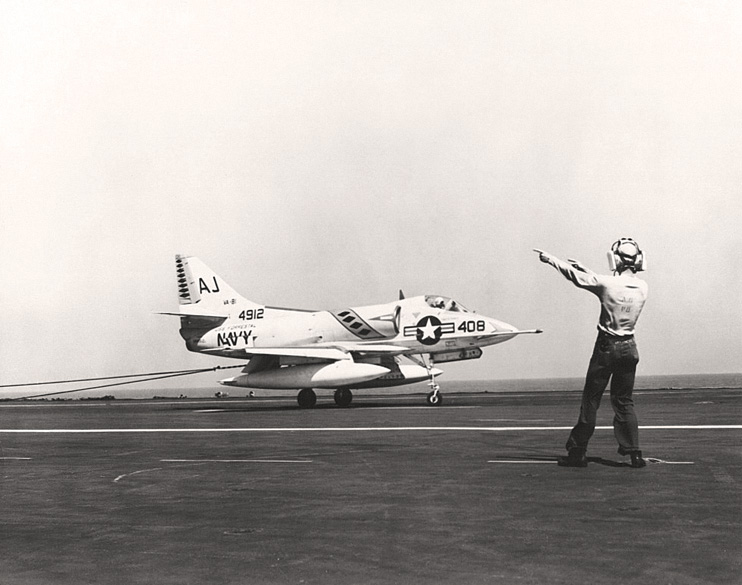
Today we continue our sojourn within the domain of the Skyhawk and bring you two photos which show jets of VA-81 'Crusaders', embarked on USS Forrestal (CV-59) as part of Carrier Air Group 8, during a Mediterranean cruise in 1962.


First up is this view of A4D-2 BuNo.144912 moments after trapping aboard Forrestal.

US Navy photo via navsource.org


And in this second photo we see A4D-2 BuNo.144919 moments before launching from the forward port cat of Forrestal.
Note the AGM-12 Bullpup missile carried on the centerline...

US Navy photo via navsource.org


With the changes made to the USA's military aircraft designation system in 1962, these A4D-2s would be re-designated as A-4Bs... within a year the US Navy's Carrier Air Groups would be officially referred to as Carrier Air Wings, and VA-81 would be renamed from 'Crusaders' to 'Sunliners'.

More A-4s to come!


Fade to Black...